

HL7 ADT messages carry patient demographic information for HL7 communications but also provide important information about trigger events (such as patient admit, discharge, transfer, registration, etc.). Some of the most important segments in the ADT message are the PID (Patient Identification) segment, the PV1 (Patient Visit) segment, and occasionally the IN1 (Insurance) segment. ADT messages are extremely common in HL7 processing and are among the most widely used of all message types.
This is a basic introduction to HL7 ADT Messages. ADT Messages are extremely common in HL7 processing and are among the most widely used of all message types. They communicate patient demographic and visit information, as well as the reason why the message is being sent. ADT messages are typically initiated by the EMR or a registration application, and are used to keep ancillary systems in sync regarding the state of a patient. When a patient’s record is updated, an ADT message is sent. This way, all systems can maintain the patient’s current contact information, insurance, and next of kin, as well as their current location and attending doctor.
There are 51 different types of ADT messages that are used for various trigger events. Some of the most commonly used ADT messages include:
- ADT-A02 – patient transfer
- ADT-A03 – patient discharge
- ADT-A04 – patient registration
- ADT-A05 – patient pre-admission
- ADT-A08 – patient information update
- ADT-A11 – cancel patient admit
- ADT-A12 – cancel patient transfer
- ADT-A13 – cancel patient discharge
Below is a sample ADT-A01 patient admit message. In the PID segment, you can find the patient’s name and contact information. The PV1 segment holds visit information such as the attending physician and the assigned patient location. The IN1 & IN2 segments are where you will find the patient’s primary and secondary insurance information.
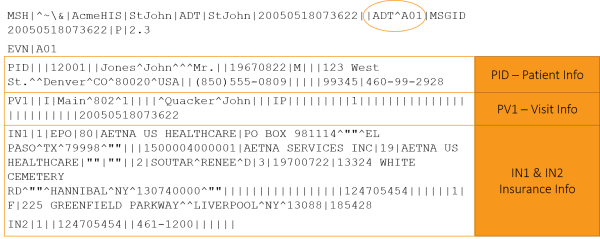
ADT messages are important in HL7 communications because they provide vital data about the patient and why the message is being sent. Trigger events are instrumental in driving message flow, because they determine when and where messages go based on the type of event that has occurred.
For instance, an ADT-A01 (patient admit) message might be sent to an Emergency Department system while an ADT-A04 (patient registration) message might be sent to an EMR system. The level of urgency and pace at which the message is transmitted might also be different depending on the trigger event.


